I try hard to give off an air of confidence. It's a big part of my day-job, and I think it's a big part of my persona. I look like someone who's life is on track, who is not worried or anxious.
But it is not true! I do worry, and I am anxious - frequently. And while I am generally very happy in my life, things are going my way mostly, that is a new story for me.
Today a radio program featuring Brene Brown really spoke to me on this topic. I was reminded that my compulsion to show how busy I am, to seem in demand and confident, is a mechanism that protects me from shame. For example, I am ashamed of how much I play a video game, or how much I sit on the couch and watch old Family Guy episodes. I am ashamed that, as I write this, I am loading a nutty youtube. I fear the shame of criticism from others. So I project confidence, diligence, focus, and accomplishment.
Parents are forced to project confidence in front of children. Men and women project confidence to each other. Leaders cover their flaws with confidence. All of this has created a confidence culture, in which we avoid vulnerability
In truth, we are all vulnerable, and our vulnerability is a key to relationship and community. Our confidence forms into walls that isolate us, preventing us from being comforted or comforting someone else. Our confidence instills a sense of independence that rejects the support of our relationships (that we desperately need, every one of us).
So open up! Fail at something! It still sucks to be vulnerable - sucks a lot - but you will be more available for the truth: we all need each other.
Friday, November 30, 2012
Wednesday, November 28, 2012
Promises to Grover
I don't usually write politics, but I heard some really remarkable commentary on the news today that touches on big ideas, big issues and commitments in a quickly evolving world.
First some background. You may know about Grover Norquist, a conservative lobbyist for tax reform, and the promoter of a "No New Taxes" pledge that has been essentially required for any conservative politician for the last twenty years.
Like any political pledge, the lobby offers to support the candidates who sign the pledge with deep money and voter networking. On the flip side, any candidate who does not wish to sign the pledge, or who at any point contradicts the lobby, can expect negative press and a bitter, well funded challenger in subsequent elections. Norquist's pledge is considered one of the most pervasive and powerful. Over 95% of House Republicans have signed, and the lobby has nearly 1.0 success rate. Norquist himself has been considered a kingmaker.
But as the national financial problems grow, politicians on both sides have more and more reasons to disregard previous pledges and make compromises. This has led to a number of high-profile Republicans dissing Norquist by name, essentially calling for party support to end the pledge blockade.
Here's the interesting thing. A former Republican congressman and governor was discussing political pledges on a talk show. "I didn't sign them because these issues are really complicated, and they get more complicated as time goes on. My constituents elected me to make good decisions on their behalf in Congress, and I did not want to give away my freedom to do that." What a basic understanding of our Democratic Republic.
Don't we all make promises? Truth is, things change. In past decades maybe we could go a decade without our core assumptions about government or religion being challenged. But today new information and opportunities constantly and rapidly become available. I think that absolute pledges are relics. I think adaptability is a new virtue.
Today, let's make fewer promises. Grover is a roundabout way to think about how quickly our world changes, and how systems that worked in previous generations simply aren't able to keep up - like political lobbies. Let's make deeper, more meaningful commitments, to which we can return in our minds when the world challenges our assumptions (frequently).
| haha, Grover |
Like any political pledge, the lobby offers to support the candidates who sign the pledge with deep money and voter networking. On the flip side, any candidate who does not wish to sign the pledge, or who at any point contradicts the lobby, can expect negative press and a bitter, well funded challenger in subsequent elections. Norquist's pledge is considered one of the most pervasive and powerful. Over 95% of House Republicans have signed, and the lobby has nearly 1.0 success rate. Norquist himself has been considered a kingmaker.
But as the national financial problems grow, politicians on both sides have more and more reasons to disregard previous pledges and make compromises. This has led to a number of high-profile Republicans dissing Norquist by name, essentially calling for party support to end the pledge blockade.
Here's the interesting thing. A former Republican congressman and governor was discussing political pledges on a talk show. "I didn't sign them because these issues are really complicated, and they get more complicated as time goes on. My constituents elected me to make good decisions on their behalf in Congress, and I did not want to give away my freedom to do that." What a basic understanding of our Democratic Republic.
Don't we all make promises? Truth is, things change. In past decades maybe we could go a decade without our core assumptions about government or religion being challenged. But today new information and opportunities constantly and rapidly become available. I think that absolute pledges are relics. I think adaptability is a new virtue.
Today, let's make fewer promises. Grover is a roundabout way to think about how quickly our world changes, and how systems that worked in previous generations simply aren't able to keep up - like political lobbies. Let's make deeper, more meaningful commitments, to which we can return in our minds when the world challenges our assumptions (frequently).
Monday, November 26, 2012
Patience
| I cannot hate you. |
We have tried using toys to make them tired all day, but we work so they have ample time to nap. And now they know how the laser pointer works. I really can't imagine spending money on toys for cats that are so much in the doghouse right now. But we know that they cannot process their behavior as bad. Cats just don't work that way.
That's the lesson that comes from cats. My way of looking and learning and growing - often through negative reinforcement - does not translate to others. I am a unique flower, and other people, other cultures, and other species, do not communicate like I communicate.
Does that pose a problem to my big picture of the cosmos as a place where we all connect? Yes and no. I don't think that connection in itself is anthropocentric; I think all matter reflects connection as well as distance.
But I do try to put myself in my cats' point of view. When has the world tried to communicate with me, and I have been deaf and annoying? Who has tried to teach me something that I simply could not learn? How can I learn faster from the authorities in my life like the planet and the town and the family?
Sunday, November 25, 2012
Sunday Prayer
As you know, I've been on a Life of Pi kick this week, in part because of the new movie and research I did for an article at Policymic. The book has struck me (again) with the level of religious content. I'm particularly fascinated by how the author, Yann Martel, connects our different "habitats" - zoo enclosures, life boats, islands, and also religions as well as the realms of fictional and nonfictional storytelling. (From chapter 28):
I loved my prayer rug. Ordinary in quality though it was, it glowed with beauty in my eyes.... Wherever I laid it I felt a special affection for the patch of ground beneath it and the immediate surroundings, which to me is a clear indication that it was a good prayer rug because it helped me remember that the earth is the creation of God and sacred the same all over....
When I prayed, the short, unknotted tassels were inches from the tip of my forehead at one end of the carpet and inches from the tip of my toes at the other, a cozy size to make you feel at home anywhere upon this vast earth.
Friday, November 23, 2012
Giving Thanks
After a post-turkey blackout brought on by a multi-course feast for two, I have reflected on the many many good things in my life.
I am thankful for the basics: I have a job that I well like, and I have a home and food, and some friends and family. I feel secure and free. I have clothes enough, and hot water. I even have a car, and a good city.
These are more than things I have. These are opportunities that grow my life. Without the physical comforts I would not feel secure enough to write in my spare time, or to pursue other skills, or to nurture friendships. If I didn't have a shower I might not have many friends in the first place. If I didn't have a car I would have struggled to do any interviews, which expanded my point of view so radically.
I spoke with people who struggle with these basics. And while a cup of coffee is great in itself, the real joy comes from participating in the coffee shop. As Christmas comes up, I remember that participation in our culture (master-narrative) requires money. I am not struggling financially, and I am thankful to be able to enjoy a thanksgiving feast, or buy a book, or art, or some plants, or gifts for loved ones, or a cup of coffee. It all comes with a price tag.
So I give thanks for my ability to participate in our community. It is the struggle of my generation, and I'm doing pretty good.
I am thankful for the basics: I have a job that I well like, and I have a home and food, and some friends and family. I feel secure and free. I have clothes enough, and hot water. I even have a car, and a good city.
These are more than things I have. These are opportunities that grow my life. Without the physical comforts I would not feel secure enough to write in my spare time, or to pursue other skills, or to nurture friendships. If I didn't have a shower I might not have many friends in the first place. If I didn't have a car I would have struggled to do any interviews, which expanded my point of view so radically.
I spoke with people who struggle with these basics. And while a cup of coffee is great in itself, the real joy comes from participating in the coffee shop. As Christmas comes up, I remember that participation in our culture (master-narrative) requires money. I am not struggling financially, and I am thankful to be able to enjoy a thanksgiving feast, or buy a book, or art, or some plants, or gifts for loved ones, or a cup of coffee. It all comes with a price tag.
So I give thanks for my ability to participate in our community. It is the struggle of my generation, and I'm doing pretty good.
Wednesday, November 21, 2012
The Life of Piscene Patel
The trailer for Ang Lee's adaptation of Yann Martel's famous book The Life of Pi
has been making waves because of its beauty. But the book deals more
closely with religion, God, humanity, and the nature of storytelling
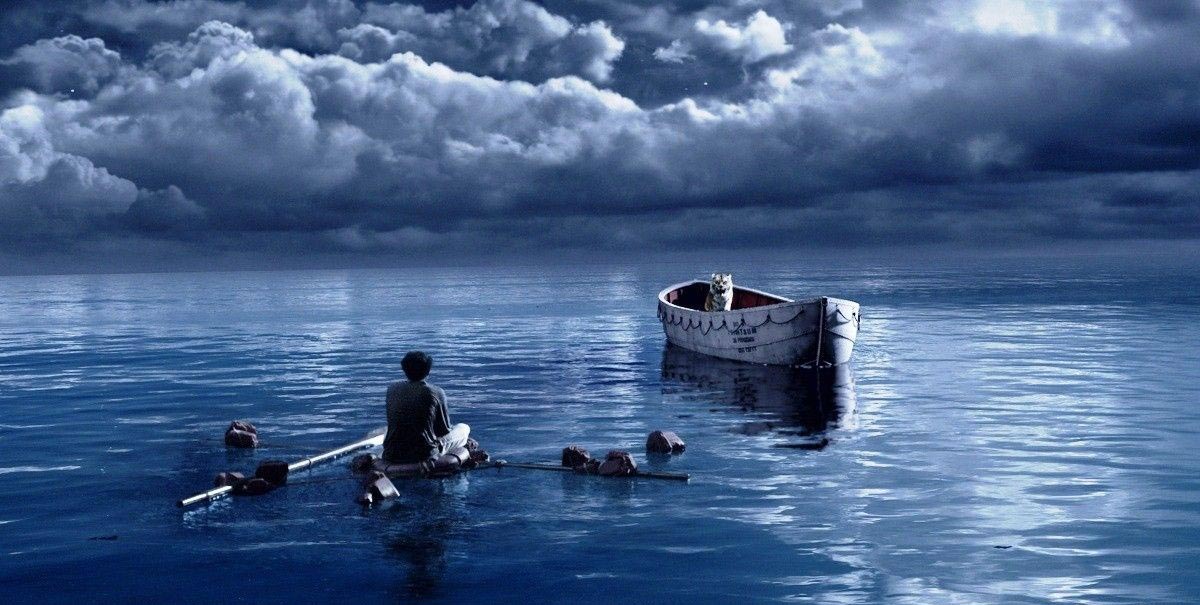
than the compelling hijinks of surviving 277 days on a lifeboat with a
Bengal Tiger.
My copy of Life of Pi has collected dust for several years, so I dutifully re-read it in anticipation of the film. I was surprised at how deeply - and naturally - the book deals with a holistic faith life. Yann Martel has claimed that, until he wrote this book as a sort of Hail Mary pass for his writing career, he called himself a secular agnostic, that is, someone who is not particularly interested in the existence of God, but who can generally see both sides of the argument for God's existence. After researching the book using the holy texts of various religions he had a breakthrough in which he understood that the world's religions were best in unison, not in division.
As Pi Patel says in Chapter 25, "To me, religion is about our dignity, not our depravity."
This point is key to the future of religious tolerance. Inter-religious dialogue - all dialogue - is rooted in the idea that we have more in common than separates us. Life of Pi reminds us that reality is much bigger than our ability to describe it, and that we should expect to be surprised. Pi Patel sees no problem in using every available brush to paint God, so he engages in Hindu, Muslim, and Christian rituals while safe in India, and calls to God in various languages while suffering in the Pacific. Martel comfortably employs the language of several religious philosophies.
The lasting value of The Life of Pi is
in showing us how to comfortably inhabit larger and larger habitats.
The first third of the book explains the finer points of zookeeping, with particular attention to the art of zoo enclosures. Then Pi comfortably inhabits different religious enclosures. Finally, as the tale of survival grows taller and taller, climaxing at the floating island, we
the reader are asked whether we can give up our enclosure of pure fact
and be comfortable in the wider habitat of narrative fiction.
Because any time we talk about God we tell stories like Yann Martel, or else we give the factual analysis that Pi finally surrenders to the Japanese interviewers.
Will Ang Lee's film deal with any of this? Unlikely. But since the book is about storytelling, we should feel deeply satisfied if the film carries us for a few hours. The previews promise at least that.
My copy of Life of Pi has collected dust for several years, so I dutifully re-read it in anticipation of the film. I was surprised at how deeply - and naturally - the book deals with a holistic faith life. Yann Martel has claimed that, until he wrote this book as a sort of Hail Mary pass for his writing career, he called himself a secular agnostic, that is, someone who is not particularly interested in the existence of God, but who can generally see both sides of the argument for God's existence. After researching the book using the holy texts of various religions he had a breakthrough in which he understood that the world's religions were best in unison, not in division.
As Pi Patel says in Chapter 25, "To me, religion is about our dignity, not our depravity."
There are always those who take it upon themselves to defend God, as if Ultimate Reality, as if the sustaining frame of existence, were something weak and helpless.... These people fail to realize that it is on the inside that God must be defended, not on the outside.
This point is key to the future of religious tolerance. Inter-religious dialogue - all dialogue - is rooted in the idea that we have more in common than separates us. Life of Pi reminds us that reality is much bigger than our ability to describe it, and that we should expect to be surprised. Pi Patel sees no problem in using every available brush to paint God, so he engages in Hindu, Muslim, and Christian rituals while safe in India, and calls to God in various languages while suffering in the Pacific. Martel comfortably employs the language of several religious philosophies.
| Reality is not as fun. |
Because any time we talk about God we tell stories like Yann Martel, or else we give the factual analysis that Pi finally surrenders to the Japanese interviewers.
Will Ang Lee's film deal with any of this? Unlikely. But since the book is about storytelling, we should feel deeply satisfied if the film carries us for a few hours. The previews promise at least that.
Monday, November 19, 2012
Isolation
| Floating in a sea of stars? |
I'm thinking about isolation lately.
That is a strange for me to write, though, because I don't actually feel isolated. I feel heard, loved, appreciated better than at any other point. I'm feeling great, the opposite of isolated, and it's good!
I look at 100,000 Stars and I love them. I'm intrigued and impressed, I feel connected. Likewise, I read Pi and I see the ways in which the title character connects with the animals, the boat, the pens, his family, and God.
But I remember times that the thought of 100,000 stars would have made me feel so small and alone. I remember first reading Pi years ago and shrinking at the ocean.
I think ours is a time of great connectivity, with communities forming around all manner of causes and joys. But it is all in potential, and the first step toward engaging communities is the hardest. All the connectivity that the world provides us now means nothing to someone who has internalized their loneliness, their isolation, their feeling of unwelcome and un-belonging. That is the great fault committed by religious organizations - casting judgment and blocking entry to all but the most committed, supported faithful.
I think that is the true test of our communities. Can we connect to each other so earnestly that we are open to someone who only sees closed doors?
Subscribe to:
Posts (Atom)