Friday, August 31, 2012

Baptism Means Introduction (Intro to Baptism)

I'm at the homestead for my nephew's Baptism. This is my favorite ritual/sacrament because it boldly, openly expresses the truth that it represents (and in representing, makes real):

Welcome, Tiny. We are your family. We have your back. 

The Christian ritual elements, like the anointing with oils, submersion under water, and lighting of candles, all take a back seat for me. Yes, the sacrament of Baptism is to introduce the baptized into the religious community. In infant baptism, the parents commit to raising the child as a Christian, rejecting Satan and all his empty promises.

Family!
But I think the Christian elements are secondary to the community elements. In our case, the gathered family represented several faiths. And while many of us are Catholic - or catholic enough for the baptism to make spiritual sense - most of us were there to show solidarity with Tiny and his parents. Our family is a community for our newest member. 

The big question is, what will all this mean in his lifetime? If you were baptized, what does your baptism mean for you today? I wonder what Tiny's baptism will mean for him in 2038, when he's my age.

By 2038, I think the way we experience and communicate our faith life will have changed dramatically. I predict that divisions between religious sects will continue to melt away, and people will continue to feel free to shop for whatever communities fill them with the most happiness. As always, I hope that religious organizations will invest in this movement, instead of building thicker walls and spreading divisiveness.

Wednesday, August 29, 2012

Isaac: A Tale of God's Will

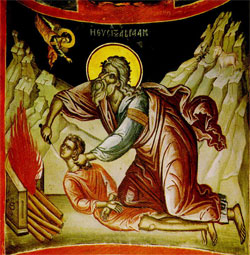
I write from New Orleans, which is today preparing for Hurricane Isaac. We are under a state of emergency, which is a technical term meant to temporarily increase responsiveness by reducing bureaucracy. The state of emergency also encourages schools and businesses to close, which means more people leaving the city and/or physically hunkering down. All this combined with the menacing clouds, heavy rain, and powerful winds give our city a sense of waiting. Like the biblical story of the Binding of Isaac, we are suspiciously glancing up to heaven, asking, "what are you doing with that knife?"

Binding of Isaac
At times of emergency we get a chance to re-evaluate what is most important in our lives. What would you evacuate with? Who would you be checking on?

I am lucky to be in my north-Louisiana Eretz Ha-Avot with my family, who I happened to be visiting. Now, during our state of emergency, I witness my family as a basic tool for preparation, coping, and recovery. In front of me sits the group from whom I learned what community is, the group who continues to be my most essential community.

As we prepare for this emergency together we build communities and strengthen networks.  
Our communities are forged around emergencies. Crisis gives us a reason to lean on each other, share our talents, and forget our differences. How often do temporary, petty squabbles keep us from connecting with our neighbors? Storms can wash those differences away. 

In New Orleans we love loudly and we create these communities easily. We don't have the same hangups about our possessions, since so many of us lost everything. Our things aren't a blockage that prevent us from experiencing healthy human relationships (I like to think).  This is the lesson of the lesson of monastic vows of poverty: if an object that you can buy at a store prevents you from a loving relationship, get rid of it. As Merton writes:
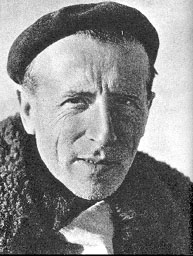
The importance of detachment from things, the importance of poverty, is that we are supposed to be free from things we might prefer to people. You can extend that to any limits you like – wherever things become more important than people we are in trouble.  Thomas Merton in Alaska
Perhaps that is the lesson of the Binding of Isaac story: do not be afraid to give up even what is most valuable to you for the sake of God, who is loving relationships.

(On the other hand, we ask exactly what emergency was present? What about Isaac's relationship with Abraham, or Isaac's own freedom? This story begs for interpretation).

Monday, August 27, 2012

Gray Areas

Why Can't Religion Handle "Gray Areas"

Sometimes issues can be cleanly, absolutely divided into good and bad. Most of us know that those days are very rare. I only hold one absolute premise, that it is good for people to do things together. We can build decisions on that premise using flexible, human judgments, without the use of an abacus.

Thomas and his book
But our religious organizations are more strict, bound together by byzantine logical systems - rules, orders, hierarchies of rights and wrongs. These are thought to be tools that simplify ethical decisions. Aquinas' 13th century Summa Theologiae standardized what a lucky few priests learned in university, and the Council of Trent in the 16th century standardized instruction for all priests (essentially creating seminaries). These two events shaped Christianity from the middle ages until the 20th century.

Aquinas and Trent used strict logical systems (partially inherited from Aristotle). These strict logical systems defined theological study as well as religious practice until WWII, existentialist philosophy, the rise of international travel and public literacy led to Vatican II and the death of 3,000 page moral handbooks. More and more, morality was seen less as a standardized list of "If...Then...", and more as a general guide that left relevant decision making to people in their context.

This is a hard transition. Rule are easy, standard, and clear, from the point of view of the establishment. From the point of view of the participant, rules are cold, relentless, an needlessly complex. It takes a deft pastor to minister to the variety of needs and contexts in the community. Professional ethicists, like those in place at catholic hospitals, have a very rough time witnessing the tragic situations of living, complicated patients while ruling according to rules that are distant and arcane.  

Rules remove compassion, which is the cornerstone of religion, and replace it with systems of control and power. To be compassionate is to give up illusions of control and share in another's suffering - to realize that I, too, can be hungry, thirsty, complicated, abused, powerless. (more on this soon, with Nouwen).

Romans treat rules differently than Americans
Context matters, too. Because of our wildly different approach to civic life, rules that make sense in Rome often seem radical in the US. That's because people in Rome don't stop at traffic lights, but we do. So in Rome people consider rules to be distant ideals that we work to achieve, but often fall short of, while in the US we consider rules to be minimum standards that we must achieve. Even the international Code of Canon Law is applied very differently worldwide, often with lots of room for "gray areas".

I'm not saying that what is considered wrong in the US is not wrong in Rome. I mean that "right" and "wrong" - the moral binary - is not a good measure of our lives together.

A better measure is our Goals. We share our goals. We work together to achieve our goals. Our gray areas disappear into collective progress to our goals.

Consider abortion, for example. One might say that life begins at conception, and any form of abortion after that time is gravely wrong. Ethical guidebooks then give a series of "If...Then...":  If preserving the health of the mother is the primary goal, and abortion is an unintended consequence, it is not gravely wrong. But science contradicts with a number of other gray areas: life does not start like a switch, it develops gradually from non-human parts. Like Theseus' Ship, at no single point can you accurately determine the beginning of human life.

When we consider abortion from the point of view of compassion instead of control, working together towards common goals, we realize that we live in a world of gray areas. We all have complicated circumstances, we all experience suffering, trauma, and regret. We are never living up to our full potential in regards to our shared goals. Instead of offering judgment by memorized medieval morals, we should seek to offer comfort and loving community.

Can religious organizations do that?


Sunday, August 26, 2012

Sunday Prayer

I've come across some really excellent examples of prayer in my research, and I'd like to introduce them to the blog as a weekly ritual. This week's prayer is from Teilhard de Chardin, circa 1937

Teilhard the Adventurer
For some of your servants, Lord, the World, our New World – the world of nuclei, of atoms and genes – has become a source of constant anxiety: because it seems to us now to so mobile, so irresistible, and so big! The increasing probability (to which we conspire to close our eyes) of other thinking planets in the firmament … the unmistakable rebound of an evolution that has become capable, through planetary effort, of governing its own direction and speed … all this seems frightening to a man who, as he still shrinks from flinging himself into the great ocean of Matter, is afraid that he may see his God burst asunder in the acquisition of a new dimension…

Yet can anything, Lord, in fact do more for my understanding and my soul to make you an object of love, the only object of love, than to see that you – the Centre ever opened into your own deepest core – continue to grow in intensity, that there is an added glow to your luster, at the same pace as you plemorize yourself by gathering together the Universe and subjecting it ever more fully to the heart of your being…?

… Lord of consistence and union, you whose distinguishing mark and essence is the power indefinitely to grow greater, without distortion or loss of continuity, to the measure of the mysterious Matter whose Heart you fill and all whose movements you ultimately control – Lord of my childhood and Lord of my last days – God, complete in relation to yourself and yet, for us, continually being born – God, who, because you offer yourself to our worship as ‘evolver’ and ‘evolving’, are henceforth the only being that can satisfy us – sweep away at last the clouds that still hide you – the clouds of hostile prejudice and those, too, of false creeds.

Pierre Teilhard de Chardin, “The Heart of Matter

Friday, August 24, 2012

Explaining Convergence

What's In a Worldview? 


My entire perspective on spirituality, meaning, and morals is directly related to my worldview, the story (or model, see last post) I use to describe the world. What is your perspective? What is the glass through which you view the world?

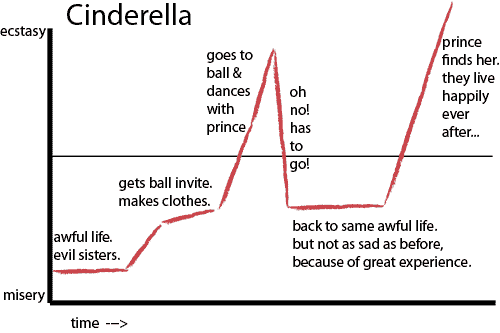
Vonnegut on Story Arc
Like any good story, my worldview has a beginning, a middle, a climax, and an end. The beginning is the Big Bang, the rising action is the development of our galaxies and finally the development of life. The end is total community between all matter, what Christians might call  Kingdom of God. That means the climax is right now, the internet age, our radical connectivity.

My universe story is largely influenced by Teilhard de Chardin. The Jesuit priest/paleontologist formulated a part scientific, part mystic evolutionary model in which all of time and space is moving towards each other converging on what he called the Omega Point. Teilhard observed that all physical matter was connected and naturally formed networks (which turns out to be more true than he knew). Likewise, he observed that people like to network and connect, and that the planet in his time (early 20th century) was getting more connected than it was before. Finally, he knew that Christianity was all about getting closer to God, with Jesus the transcendent as a model.


Teilhard imagined the universe in terms of concentric spheres of interconnection. We know we are connected as a planet in terms of geosphere and atmosphere. We know we are connected as living things in terms of ecosphere. We are also connected as thinking, spiritual things in what Teilhard calls the noosphere.

I think this is the holiest, most helpful model for Christianity - we imagine different planes of existence (heaven and earth, God and world, other and us) and we revere those who connect them (mystics, teachers, saints, prophets). Jesus achieves his saving power by being fully connected to all planes simultaneously. Our goal, then, has always been to follow Jesus as closely as possible to bring about the Kingdom of God, or the perfect community between divine and terrestrial planes.

The more we learn about our world the more I am inclined to trust Teilhard. When viewed in large scale we observe that galaxies form clusters, like nodes in a network. Galaxy superclusters are vast assemblages of thousands of galaxies or more. The voids between filaments can be billions of light years across:

Galaxy clusters in red, voids in blue.
Similarly, the internet can be visualized as a hierarchy of connections tending towards merger, or increased levels of connection: 

visualization of the internet, arranged by connectivity

Vive Omega Point!
This is why I say that promoting connection, community, and love is the essential human goal. From data and experience I think we are moving towards each other on all levels, and I think that is a great thing. 


Wednesday, August 22, 2012

Telling Tales About God

Last weekend I had a great conversation with a stranger who, when I mentioned my blog, immediately started talking about narratives: arranging the world into stories with plots, climaxes, and resolutions.

Narratives, metaphors, and models are huge to me. When I say "re-imagine religion" what I mean is adopt a different religious model, a new narrative interpretation of our stories about God.
 
Religious language is necessarily metaphorical, and any attempt at literalism is nothing short of idolatry. There is a distance between human words and the human experience of God. Therefore, our scriptures are an incomplete and imperfect manifestation of God’s presence in history. When we choose to explain a spiritual experience, the explanation relies on imagery and metaphor because of the gulf between the possible literal meaning of words and the hugeness of our spiritual experience. 

Take Genesis for example. It would be impossible for 3nd century BCE nomads to literally explain the origins of the universe, so they told stories. Storytelling (narrative fiction) is at the heart of the Genesis account of creation. It was designed as a story for telling long before it was written into static words on a page. It was built to be flexible enough to suit a variety of instructional goals in a variety of settings. It is nonsense to treat the words recorded on a page (after numerous translations) as literal and unchangeable in the 21st century. 

Religious literalism congeals the narrative of God into a theory of God at the cost of religious innovation and creative potential. The cure is to recognize the narrativity of our religious stories. 
yes, we all have a right to tell stories

A model is simply a story that is told with a point. When I write of the history of the evolution of humankind into stronger and stronger communities, and I incorporate the internet into that as our climactic moment, I am spinning facts into a narrative. Then I'm merging that narrative with pre-existing narratives from Christianity into a model to promote community and loving interaction. We have a right to tell stories because that's what we've always done. 

In Our Millennium, Genesis is within reach. For the first time in the history of the earth, we have the knowledge and the language to literally explain the origin of the universe without metaphor or fictional narrative. I barely have the language to express how important that is, how this is the most exciting time that has ever existed for humanity, how we are entering into a wholly new era of human history. However, we continue to take factual data and spin it into metaphors - that is a human way to absorb and interpret data. And we continue to find value in religious stories, even though we can show them to be without any factual content. 

I am excited to turn our breathtaking new data into stories. 
 

Monday, August 20, 2012

No Goals, No Regrets


Some People Hate Setting Goals. 

I was describing my attempt to re-formulate religion according to participants' goals to a coworker who quickly shot me down by saying, "I don't set goals. I don't like regrets, and no goals means no regrets." I did not manage the conversation very well after that.

I've thought about that statement for a week, and I've finally formulated my response. It's kinda zen, so breathe deeply and hold on.


Even if you know nothing about zen except what you see in this glossy picture, you probably think it's about removing clutter from life. Congratulations- as much as zen can ever be defined, it is certainly about removing clutter from life. Clutter comes in many forms: objects, possessions, obsessions, addictions, mindsets, etc. The regret and guilt that is associated with not achieving a goal is a form of clutter that prevents us from living fully, being happy, and doing the things we want to do.

For example, I set a goal of updating the blog three times every week. I really forced some of the posts, and when I read them they feel uninspired. Eventually I missed a week, and the guilt I felt actually prevented me from writing, and it made me irritable at home. In this case, my goal cluttered my life and blocked me from doing the thing I want to do.

I totally get where my coworker is coming from. As much as I love to outline a monthly agenda, point by point, I admit that goal-setting hasn't always been successful for me. I love to walk aimlessly and appreciate wherever it is I end up. I am well practiced at being happy while washing dishes or commuting to work. And I agree one deeply misunderstands religion when one thinks of it in terms of working towards a set of goals (like the Kingdom of God).

We Just Do It.
But when I say that we use religion to achieve goals, I mean it rather differently. We use religion to achieve goals in the same way we use breathing to live. Religions - that is, rituals, community, and narratives - have evolved with us as essential tools for humans. We have evolved to work together, so sharing, communicating, and connecting are human goals in the same way that we have evolved to breathe oxygen, therefore breathing oxygen is a human goal. 
In the future we can imagine humans breathing more efficiently, using whatever air we have available. We even see humans using technology to breathe better - inhalers, SCUBA, nasal strips, spacewalks. But this goal is not something we can plot out and measure with dates and statistics in the same way I can measure the success of my monthly writing goals. Failing to breathe well or improve our breathing according to plan shouldn't fill us with regret and shame.

Likewise, in the future I imagine humans getting better at building community. We use technologies to communicate better - phones, satellites, airplanes, internet. But this goal of total loving community (aka the Kingdom of God) is not a goal we can plot and measure. Failing to improve a certain percentage this quarter should not lead to shame and regret that will clutter our future. Forgiveness is better than self-flagellation.

In summary, what I'd tell my coworker is that we share these particular goals, and that very fact helps us achieve these particular goals. The only penalty for not achieving them isn't regret or shame, it's another day of life as we know it.